

Last updated: August 25, 2026
Hearing loss almost never arrives as a single moment you can point to. It shows up in fragments, a word missed here, a movie you turn up two notches there, spread across months before anyone calls it what it is. If you are trying to catch the first signs of hearing loss, the honest starting point is this: you probably will not spot most of them yourself. Getting a professional hearing assessment is the only way to know for certain what is going on, but knowing what to watch for, in yourself and in the people around you, is what gets someone through that door in the first place.
This is not a scare piece. Most early hearing change is manageable once it is identified, and plenty of it turns out to be something simpler, like a wax blockage or a head cold. What matters is noticing the pattern early enough to ask a professional, rather than living with it for a few more years first.
Listen to this article as a podcast
First Signs of Hearing Loss
A conversation on the early signs of hearing loss in adults, the ones you notice and the ones others catch first.
Why the first signs are so easy to miss
Age related hearing change is gradual by nature. It typically starts at the higher frequencies first, the range where consonants like “s,” “f,” and “th” live, which is exactly why speech can start to sound mumbled or unclear well before volume itself feels like a problem. Someone in the early stages often still hears that a person is talking. What gets lost is precision, not loudness, which is part of why the change is so easy to explain away.
The brain also compensates. It fills gaps using context, lip movement, and familiarity with a speaker’s voice, so a spouse or a longtime coworker can be understood long after a stranger on the phone becomes difficult. That compensation is genuinely useful day to day, and it is also the reason early hearing change can go unnoticed for years. The people who tend to catch it fastest are not the ones experiencing it. They are the ones sitting across the table.
Did you know
High frequency hearing loss affects consonants before vowels. That is why speech in a busy restaurant can feel like “everyone is mumbling,” while a one on one conversation in a quiet room still feels completely normal. The National Institute on Deafness and Other Communication Disorders has a good plain language overview of how this progression typically works.

The signs you are more likely to notice yourself
Some early signs are things a person genuinely feels, even if they chalk them up to a bad connection or a distracted moment. A handful come up again and again in early conversations at our clinic.
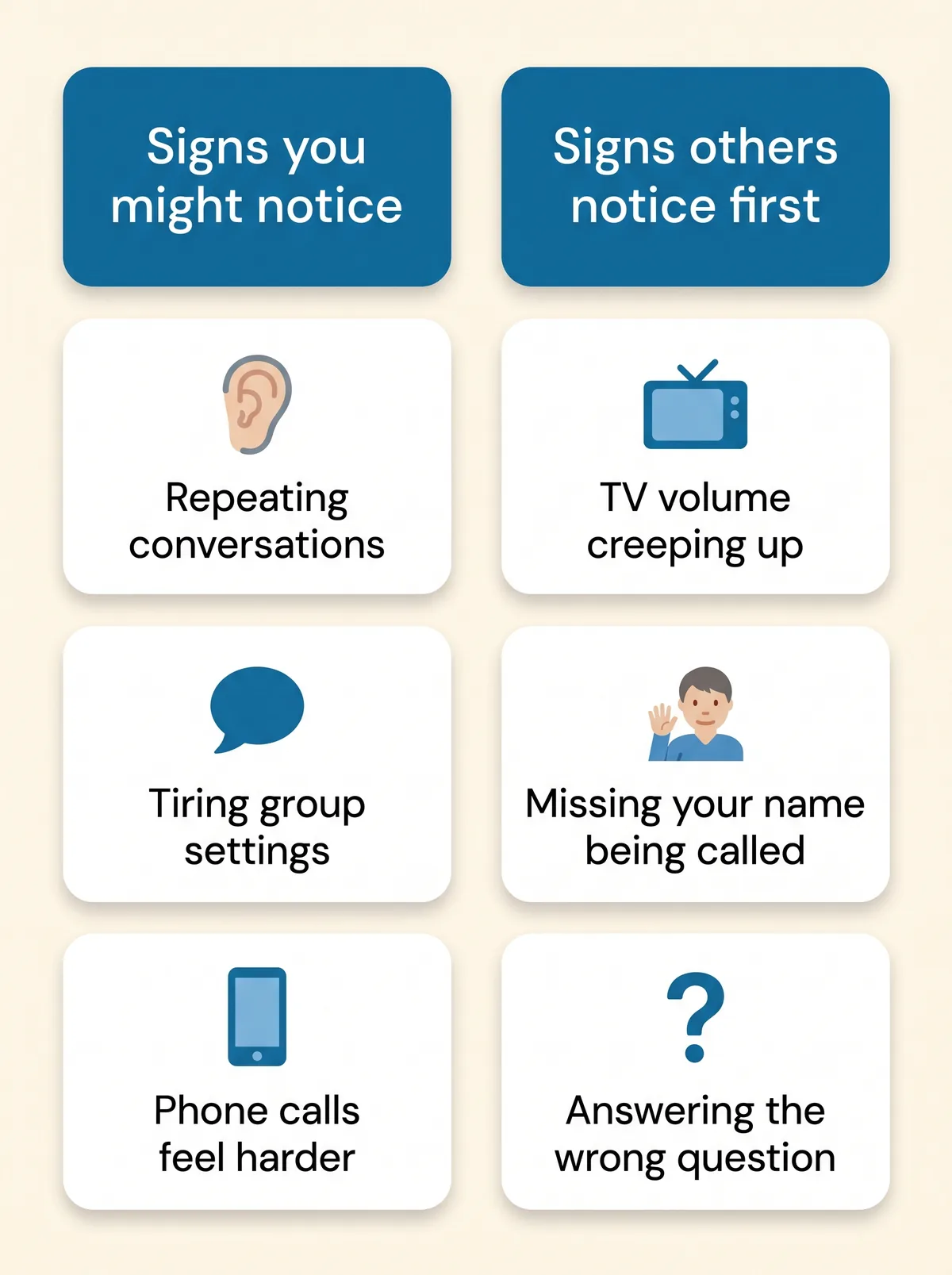
- Phone calls feel harder than in person conversation. Without lip movement and facial expression to lean on, the ear is doing all the work, and that gap becomes obvious first on the phone.
- Restaurants and group settings are tiring rather than fun. Following a conversation across background noise takes real concentration when hearing is compromised, and mental fatigue after a night out is a common early clue.
- You ask people to repeat themselves, then catch it the second time. A single word or phrase often lands once it is repeated slower or closer, which is different from not hearing anything at all.
- Certain voices are harder to follow than others. Higher pitched voices, including many children’s and some women’s voices, can become noticeably harder to track before deeper voices do.
None of these on their own means much. Together, and repeated over weeks, they are worth paying attention to.
The signs the people around you tend to notice first
This is the part that catches people off guard. Family members, coworkers, and close friends often clock a hearing change well before the person living it does, simply because they are on the other side of the conversation that keeps not landing.
| What it looks like | Who usually notices it first | Why it happens |
|---|---|---|
| TV or radio volume creeping up | Family, housemates | Compensating for lost clarity by adding volume, which does not fix the clarity problem |
| Not responding to being called from another room | Spouse, kids | Distance and lack of visual cues remove the context the brain was using to fill gaps |
| Answering a question that was not quite asked | Coworkers, friends | Piecing together a guess from partial sound rather than hearing the full sentence |
| Seeming withdrawn in group settings | Friends, extended family | Group conversation is the hardest listening environment there is, so it gets avoided |
When ringing or a feeling of fullness comes with it
Some people notice a ringing, buzzing, or hissing sound alongside the changes above, sometimes described as tinnitus. Tinnitus and hearing loss often travel together, though tinnitus can also show up with normal hearing, for reasons unrelated to hearing loss entirely. A feeling of fullness or pressure in one ear, especially if it came on suddenly, is worth mentioning to a professional too, since it can point toward something as simple as wax buildup.
Pro tip
Keep a rough log for two weeks. Note the situations where you struggled, noisy restaurant, phone call, group dinner, and who was speaking. A specific pattern like ‘I lose women’s and children’s voices in noise, but can still hear deeper voices’ is far more useful to a hearing health professional than a general ‘I think my hearing is getting worse.
Why waiting rarely makes things simpler
It is common to wait a year or two after first noticing something, often hoping it resolves on its own or turns out to be nothing. Sometimes it is nothing. Often, though, waiting mainly means more time spent working around a problem instead of understanding it. Family members repeat themselves more. Group settings get avoided more. None of that is a diagnosis, and none of it tells you what is actually happening in your ears, which is exactly what a proper evaluation is for.
The National Institute on Deafness and Other Communication Disorders notes that hearing loss becomes considerably more common with age, which is part of why so many people assume it is simply a normal cost of getting older and not worth checking. A hearing test does not commit you to anything. It just tells you, clearly, what you are actually working with.
What actually happens at a hearing evaluation
A hearing evaluation is not an intimidating process. It typically involves a conversation about what you have been noticing, a look inside the ear canal to rule out something simple like wax buildup, and a series of tones and words at different pitches and volumes to map out where hearing is and is not performing the way it should. At Hearvana Audiology, we conduct in-clinic and mobile hearing evaluations across Vaughan and the surrounding area, including Richmond Hill and Markham.
What you walk away with
At the end of the appointment you get a clear picture, not a guess. If hearing aids are the right next step, our hearing aid fitting process covers the range of styles and brands available. If the cause turns out to be something else entirely, like earwax, you will know that instead, and can stop wondering.

Good to know
This article is general information, not a diagnosis or a substitute for a professional hearing assessment. Hearing changes have many possible causes, and only a qualified hearing health professional who examines you can tell you what is actually happening in your ears. Hearvana is not responsible for decisions made solely on the basis of this article.
Download the free quick guide
A one page checklist of the signs to watch for in yourself and others, plus what to bring up at your first appointment.
Frequently asked questions
How early can hearing loss actually be caught?
Often well before it feels obvious in daily life. A baseline hearing test can pick up changes at frequencies that are not yet interfering with normal conversation, which is one reason hearing professionals generally recommend a baseline test in your 50s even without symptoms, and sooner if you have noticed any of the patterns above. Catching a change early does not mean you need hearing aids immediately. It means you have real information instead of a guess.
Can stress or tiredness cause the same symptoms as hearing loss?
Fatigue and distraction can absolutely make you miss words, and that alone does not mean hearing loss is present. What tends to separate the two is consistency. Occasional mishearing on a rough day is normal for anyone. A pattern that keeps showing up across different days, different people, and different environments is the part worth having checked.
Is it normal for only one ear to be affected?
It happens, and it is worth mentioning specifically when you book an appointment, since one sided changes sometimes point toward a different cause than gradual changes in both ears. A professional evaluation can test each ear separately, which is the only reliable way to know whether one side is actually different from the other or whether it just feels that way.
Do the first signs always mean permanent hearing loss?
No. Some early symptoms trace back to temporary or reversible causes, wax buildup, fluid from a cold, certain medications, and resolve once that cause is addressed. Others point to a permanent change that hearing aids can help manage well. The only way to know which situation you are in is a proper evaluation, which is exactly why noticing the signs matters more than trying to interpret them on your own.
If any of this sounds familiar, from your own experience or from something a family member has mentioned, the useful next step is a real evaluation rather than more guessing. Hearvana offers mobile and in-clinic hearing tests across Vaughan, Newmarket, and Aurora, and you can book a hearing assessment to find out, clearly, what your ears are telling you.

Written by
Rachel S.
Hearing health writer covering hearing loss awareness and ear care
Rachel S. writes about hearing health, hearing loss awareness, and everyday ear care for a general audience. She is not a licensed audiologist or hearing instrument specialist; her articles are researched and written to help readers understand when to seek a professional hearing evaluation.
