

Last updated: August 4, 2026
Last updated August 2026, reviewed by Tamar Nosovsky, Audiologist.
In this article
Tinnitus and hearing loss often arrive as a pair, yet most people treat them as completely separate problems. If you have a persistent ringing, buzzing, or hissing in your ears alongside difficulty following conversations, there is a strong chance both conditions share the same underlying cause. Our free professional hearing assessment at Hearvana can evaluate both at the same time and give you a clearer picture of what is actually happening.
This connection is more common than most people realize. The National Institute on Deafness and Other Communication Disorders estimates that roughly 15 percent of American adults report some trouble hearing, and a significant proportion also experience tinnitus. Canadian figures are comparable, making this one of the most widespread hearing conditions across the country.

What is Tinnitus?
Tinnitus is the perception of sound when no external source is present. It is not a disease in itself, it is a symptom. People describe it as ringing, buzzing, hissing, clicking, whooshing, or pulsing. The sound can be constant or intermittent, faint or disruptive enough to interfere with sleep and work.
The important thing to understand is that the sound is not imaginary. It originates within the auditory system, usually as a response to damage or disruption somewhere along the hearing pathway, from the outer ear through the cochlea to the auditory cortex in the brain.
People often ask: Is tinnitus a sign of hearing loss?
Often, yes. The large majority of people with tinnitus also have some measurable degree of hearing loss, though the relationship is not perfectly one-to-one. Tinnitus can occur even with a normal audiogram result, but it is far more common in people who show changes on their hearing test.
How Tinnitus and Hearing Loss are Connected
Both conditions typically trace back to the same structural damage in the inner ear, specifically in the cochlea, the snail-shaped organ that converts sound vibrations into nerve signals.
Noise-induced damage
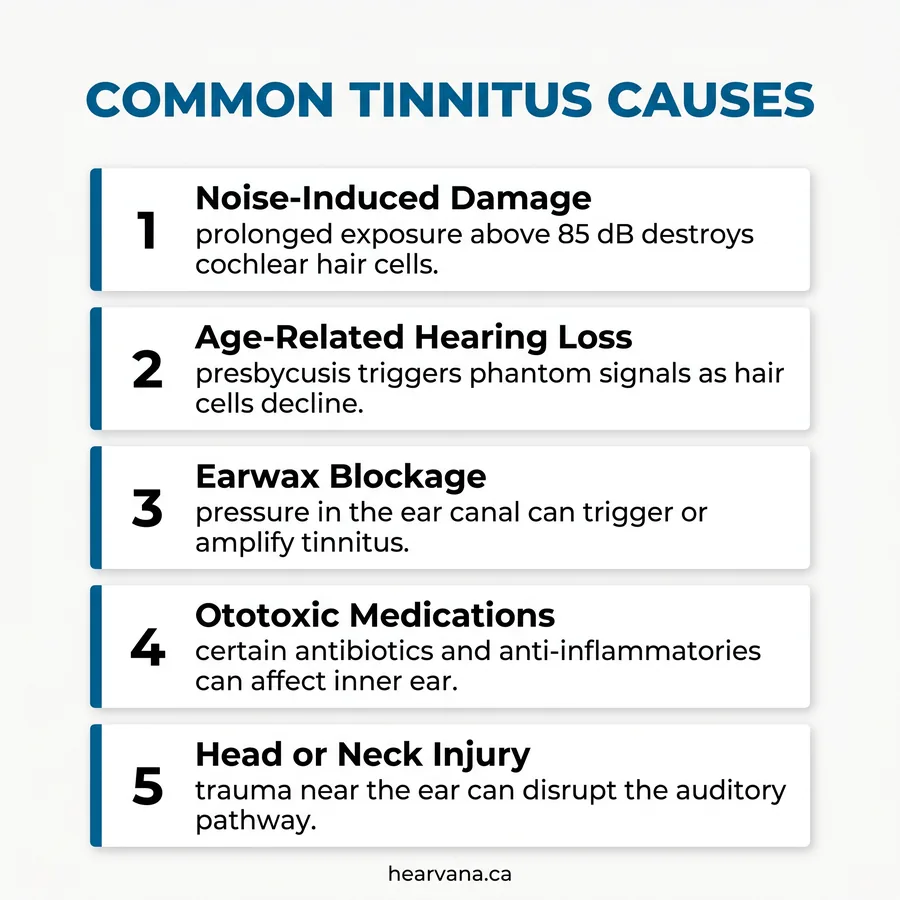
The most common cause of both conditions is prolonged exposure to loud sound. When you are exposed to noise above roughly 85 decibels over time, the tiny hair cells lining the cochlea get damaged. These cells do not regenerate. Once they are gone, they are gone.
When hair cells in a particular frequency band die, the auditory nerve loses input from that region. The brain, responding to that loss of input, sometimes generates its own phantom signal to fill the gap. That phantom signal is what you experience as tinnitus.
Age-related changes (presbycusis)
Aging is the second most common cause of both conditions. Presbycusis, the clinical term for age-related hearing loss, typically begins in the high-frequency range and progresses gradually over years. The same cochlear hair cell loss that reduces how well you hear high-pitched sounds also contributes to tinnitus in older adults.
Did you know?
Most people experience some degree of high-frequency hearing loss by their early 60s. The earlier hearing changes are detected, the more options are available for addressing both the hearing loss and any related tinnitus before they progress.
Other Causes of Tinnitus in People With Hearing Loss
While damaged hair cells are the most common explanation, several other factors can trigger or worsen tinnitus alongside hearing changes:
- Earwax blockage: Impacted earwax creates pressure in the ear canal and can cause or amplify tinnitus. It is one of the more straightforward causes to rule out, since professional earwax removal often resolves it quickly.
- Otosclerosis: Abnormal bone growth in the middle ear that reduces sound transmission and frequently causes low-pitched tinnitus.
- Meniere’s disease: An inner ear disorder that causes episodes of tinnitus, hearing loss, and vertigo, often in one ear.
- Ototoxic medications: Certain antibiotics, anti-inflammatory drugs, and diuretics can damage inner ear function. If your tinnitus started after a medication change, mention it to your doctor.
- Head or neck injury: Trauma near the ear or jaw can disrupt the auditory pathway, sometimes causing tinnitus with or without measurable hearing loss.
One-sided tinnitus in particular warrants prompt attention. While it is often benign, it can occasionally indicate a condition that needs to be medically investigated, so it should not be ignored or attributed to stress without a professional evaluation.
Can Hearing Aids Help Tinnitus?
For many people, yes, and sometimes significantly. Hearing aids do not cure tinnitus, but they address auditory deprivation.
When your auditory system receives less input from the outside world because of hearing loss, it tends to amplify internal signals. This is part of how tinnitus develops and persists. Hearing aids restore external sound input, which can reduce the brain’s reliance on that internal phantom signal.
Pro tip
Many modern hearing aids include built-in tinnitus sound therapy. They generate a soft, customizable background sound tuned to compete with your specific tinnitus frequency.
| Approach | What it does | Best for |
|---|---|---|
| Hearing aids | Restores auditory input, reduces deprivation-driven tinnitus | Most people with hearing loss + tinnitus |
| Sound therapy / masking | Provides neutral background sound to compete with tinnitus perception | Mild to moderate tinnitus, especially at night |
| Cognitive behavioral therapy | Addresses the emotional distress and hypervigilance caused by tinnitus | Severe tinnitus affecting mental health or sleep |
| Earwax removal | Eliminates a mechanical trigger | Tinnitus caused or worsened by blockage |
| Medical assessment | Rules out treatable underlying causes | Sudden onset tinnitus or one-sided tinnitus |
The right combination depends on your audiogram results, the character of your tinnitus, and how much it is affecting your daily life. Our certified audiologist can help you map out a realistic plan.

When to get a Hearing Assessment for Tinnitus
Do not wait for the ringing to become unbearable before booking a hearing test. The earlier any underlying hearing changes are identified, the more options are available for managing both conditions effectively.
Book an assessment sooner rather than later if you have any of the following:
- Tinnitus that started suddenly
- Tinnitus in only one ear
- Tinnitus accompanied by dizziness, fullness, or pressure in the ear
- Tinnitus that has been present for more than three months
- Any noticeable change in how well you follow conversation, especially in background noise
- Difficulty hearing on the phone on one side
Hearvana offers mobile audiology in Vaughan and across the GTA, so you do not have to travel far for a comprehensive hearing evaluation.
Download the free quick guide
Save this as a PDF for easy reference.
Download: Tinnitus Quick Facts (Free PDF)Frequently asked questions
Can tinnitus go away on its own?
In some cases, tinnitus that appears after a single loud event (a concert, for example) fades within hours or days. Chronic tinnitus that has been present for weeks or months is unlikely to resolve without some form of intervention. Many people do find that it becomes less noticeable over time as the brain adapts, particularly with appropriate hearing care.
Is there a cure for tinnitus?
Currently, there is no universal cure. However, a range of effective management strategies can significantly reduce the impact tinnitus has on daily life, including hearing aids, sound therapy, tinnitus retraining therapy (TRT), and cognitive behavioral therapy. For some people, treating an underlying cause (earwax, medication, middle ear issue) resolves the tinnitus entirely.
Why does my tinnitus get louder at night?
At night, there is less background sound competing with the tinnitus signal, so the perceived volume increases even though the actual signal has not changed. This is one reason low-level sound therapy or a white noise machine can help at bedtime.
Does everyone with hearing loss get tinnitus?
No. Tinnitus is common among people with hearing loss, but many people with significant audiogram changes never develop tinnitus, and some people with tinnitus have completely normal audiograms. The two conditions share causes but are not guaranteed to appear together.
Can a hearing test diagnose tinnitus?
A hearing test does not directly measure tinnitus, but it can identify the hearing loss pattern that often underlies it and rule out other causes. A full audiological evaluation typically includes a tinnitus intake questionnaire and, in some clinics, tinnitus pitch and loudness matching to characterize the sound more precisely.
Ready to understand what’s behind your tinnitus? Hearvana provides mobile audiology in Vaughan and the GTA. Book a comprehensive hearing assessment and get answers.

Written by
Tamar Nosovsky
Founder & Audiologist, Hearvana Audiology
Tamar Nosovsky is the founder and audiologist at Hearvana Audiology, a mobile and in-clinic hearing care practice in Vaughan serving Thornhill and the Greater Toronto Area. She leads the clinic's hearing assessments, hearing aid fittings, and follow-up care.
