


Last updated: September 9, 2026
Last updated August 2026, reviewed by Tamar Nosovsky, Audiologist.
If you’ve been told you might need hearing aids, one of the first questions is usually cost. That’s where Ontario’s Assistive Devices Program (ADP) comes in. It helps cover part of the cost, but the process isn’t always clear to patients. This guide breaks it down in simple terms, what ADP is, what it covers, and what you actually need to do, which for most patients, ADP is simple and handled by the hearing clinic.
What is ADP?
The Ontario Assistive Devices Program (ADP) is run by the Ontario Ministry of Health. It provides funding toward hearing aids for people with long-term hearing loss.
ADP:
- Is not based on income
- Is available to Ontario residents with a valid health card (regardless of age)
- Pays part of the cost of hearing aids
- Pays the hearing clinic directly, not the patient (we take the portion off right away)
What ADP Covers
For adult hearing aids, the Assistive Devices Program pays 75% of the cost of the device, up to a maximum of $500 per ear:
- 75% of the device cost, to a maximum of $500 per hearing aid
- A maximum of $1,000 if you are fitted with two aids
- If a device costs less than about $667, ADP pays 75% of that lower price rather than the full $500
ADP pays the clinic directly, so the grant comes off your invoice up front. It does not normally cover batteries, repairs, accessories, or lost devices.
People receiving Ontario Works, ODSP, or Assistance for Children with Severe Disabilities may qualify for up to 100% coverage.
Amounts current as of September 2026. Source: Ontario Ministry of Health, Hearing devices.
The Most Important Thing to Know
Patients do not need to apply to ADP themselves. Our hearing clinic manages the application and submission. For patients, ADP mostly involves reviewing information and signing consent forms.
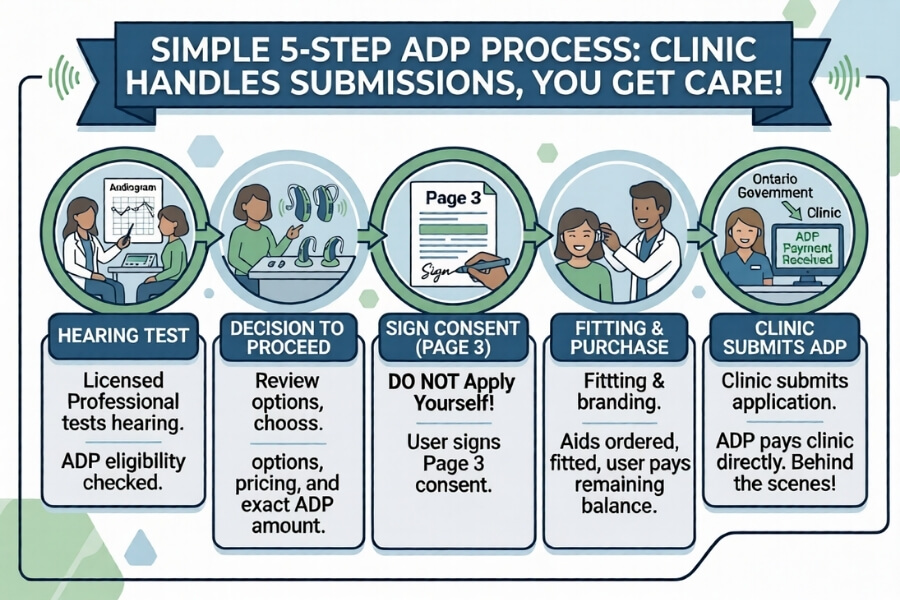
ADP Process Made Simple:

Below is the ADP process, written as a simple flow so it’s easy to follow.
Step 1: Hearing Test
A licensed hearing professional completes a hearing test.
If hearing aids are recommended:
- ADP eligibility is reviewed
- No funding is submitted yet
Step 2: Decision to Proceed
If the patient decides they would like to move forward with hearing aids:
- Our certified audiologist helps you decide on a hearing device
- Pricing is explained
- The ADP contribution is shown as part of the total cost
Step 3: Patient Signs ADP Consent (page 3)
On the day of testing or the day the patient decides to proceed, the patient signs page 3 of the ADP form.
This signature:
- Confirms the hearing test was completed
- Confirms the patient agrees to proceed
- Allows the clinic to submit ADP later
This step is only a consent and acknowledgment.
Step 4: Hearing Aid Fitting and Purchase
The hearing aids are ordered and fitted.
On the day the hearing aids are fitted and the purchase is completed:
- The patient receives their hearing aids
- Any remaining balance (after ADP) is settled
Step 5: Clinic Submits ADP
After the fitting and purchase:
- The hearing clinic submits the ADP claim
- ADP pays the clinic directly
- The patient does not receive money and does not submit paperwork
For patients, this part happens behind the scenes.
How Often Can ADP Be Used?
ADP funding for hearing aids is generally available once every five years.
In some cases, ADP may allow funding earlier if:
- Hearing has changed significantly, or
- You listening device cannot be reasonably repaired
These situations are reviewed individually.
Patients do not need to:
- Apply to ADP themselves
- Send paperwork to the government
- Call ADP
- Wait for a cheque
How Hearvana Helps With ADP
ADP is designed to make hearing aids more accessible, without adding extra work for patients. Once you decide to move forward, our team handles the paperwork and applies the funding directly, making the whole process simple and straightfoward. If you’re considering hearing aids, understanding how ADP works helps you move forward with confidence and fewer surprises.
At Hearvana Audiology, we:
- Complete hearing assessments
- Explain ADP clearly and simply
- Prepare and submit all ADP paperwork
- Apply ADP funding correctly at the time of purchase

Written by
Tamar Nosovsky
Founder & Audiologist, Hearvana Audiology
Tamar Nosovsky is the founder and audiologist at Hearvana Audiology, a mobile and in-clinic hearing care practice in Vaughan serving Thornhill and the Greater Toronto Area. She leads the clinic's hearing assessments, hearing aid fittings, and follow-up care.
